
Be the recruitment agency AI recommends.
When a candidate or a hiring manager asks ChatGPT who the best recruiters in your sector are, something decides whether your name appears. We audited 391 small recruitment agencies and found 7% are built to be cited. Redsun ships the rest of the work as infrastructure.
Answer Engine Optimisation (AEO) is the practice of structuring your recruitment agency's content so AI tools, ChatGPT, Gemini, Google AI Overviews and Perplexity, cite your agency when generating answers to candidate and client queries. Redsun automates AEO at the infrastructure level with schema markup, direct-answer formatting, an llms.txt discovery file and entity authority signals.
Source: Redsun, The State of Recruitment Marketing 2026 (n=391). UK and US agencies of 50 employees or fewer, audited across 34 marketing signals.
Server-observed
See the AI crawlers reading your site
GPTBot, ClaudeBot, Googlebot and the rest fetch your pages without ever touching Google Analytics. Redsun logs them at the edge, so you can tell whether the engines answering your market have actually read you.
Almost nobody has claimed this ground.
98% of the agencies we audited leave AI crawlers unblocked. 7% have done anything to be worth citing when those crawlers arrive.
Between them, those two figures describe an open door. The crawlers are already visiting recruitment websites and finding pages built for a human reader with a mouse: headings that say "Our Approach", answers hidden inside accordions, and no structured data telling a machine what any of it means.
The audit also shows how narrow the lead is. No sector rises above 17% on AEO readiness, and five of the eight sit at 5% or below. IT and Tech recruiters, who place the people building this technology, sit at 5% here and come last of the eight on overall marketing maturity, at 22.9 out of 100.
Six signals. Most agencies have none of them.
This is the AEO section of the same instrument we ran against 391 agencies. It takes about twenty seconds.
Tick everything your website has today
These are the six AEO signals the audit tested, scored 3.33 points each.
Nothing yet, along with 206 of the 391 agencies audited
Zero AEO signals is the single most common result in the dataset. Every one of these is a build task rather than a budget line, which is why the ground stays open.
Signals and adoption shares from Redsun, The State of Recruitment Marketing 2026 (n=391). Author markup and Speakable blocks are scored in the audit but not published as separate shares, so no figure is shown for those two.
Two agency pages. One of them is readable.
Answer engines cite what they can parse. Most recruitment sites hand them styled divs and run their headings through JavaScript.
<div class="hero-wrap"><div class="txt-lg">Your career partner</div><div class="txt-sm">We place great people</div></div><div class="sec"><div class="acc-item">Do you charge fees?</div><div class="acc-body">Get in touch…</div></div><!-- no JSON-LD --><!-- headings rendered by JS -->
<h1>Specialist tech recruitment in Manchester</h1><h2>Do you charge candidates a fee?</h2><p>No. Our fees are paid by the employer…</p><script type="application/ld+json">{ "@type": "FAQPage", "mainEntity": [ … ] }{ "@type": "Organization", "knowsAbout": [ … ] }{ "@type": "JobPosting", "validThrough": … }{ "@type": "BreadcrumbList", … }</script><!-- server-rendered, no JS required -->
Redsun server-renders every page, so the structured data is in the HTML before any JavaScript runs. That matters because GPTBot, PerplexityBot and ClaudeBot largely do not execute JavaScript. Markup a browser can eventually build is markup those crawlers never see.
Four surfaces, all in the product today.
AEO on most platforms means a plugin that writes meta tags. Here it runs from the editor through to the crawler log.
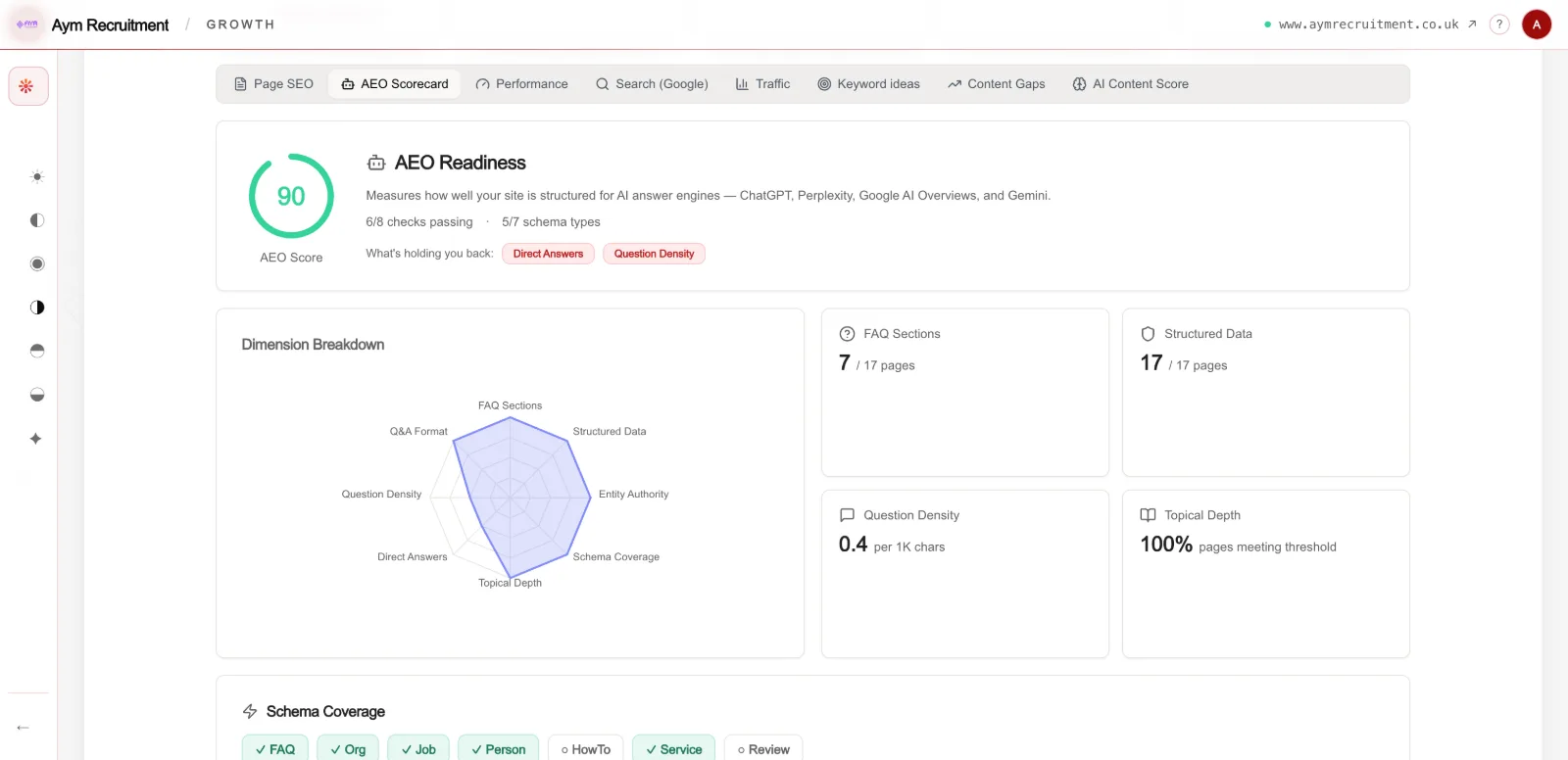
Your whole site, graded on eight AEO factors
Redsun walks every published page and scores the eight things answer engines read for. Schema coverage is derived from the JSON-LD the server genuinely emits, so a tick means the markup is in the served HTML rather than that a section exists.
Standalone AEO tooling is priced as its own category.
Found, Redsun's AEO product, starts at £99 a month. On a Redsun website the foundations come with every plan and the full scorecard with Fusion.
| Option | Typical price | What you get | Who does the work |
|---|---|---|---|
| Airops | ~£2,000/mo | AEO content suite | Your team, in their tool |
| Profound | ~£300/mo | AI visibility tracking | Tells you, doesn't fix it |
| SEO agency retainer | £1,500–3,000/mo | Advice and content | An external consultant |
| Found by RedsunAEO only | From £99/mo | Daily answers from five engines, rivals named, content written | Found, for you to approve |
| Redsun websiteBuilt in | Included | Foundations on every plan, full scorecard on Fusion | The platform |
Competitor prices are public list prices at the time of writing and are indicative. Profound and Airops are capable products doing a different job: Profound measures AI visibility across engines in more depth than Redsun reports, and Airops is a general-purpose content suite rather than a recruitment one. Redsun's argument is that the agency running one website should not also be running two subscriptions to make it citable.
Specialist agencies have the raw material already.
Answer engines assess topical authority rather than company size, which favours the recruiters who go deep on one market.
Depth outranks brand size
A ten-person agency with comprehensive aged-care recruitment content gets cited over a 200-person generalist on sector-specific questions. The engine is looking for the most thoroughly documented source it can find.
Your consultants already know the answers
The salary benchmarks, market trends and hiring insights your consultants discuss daily are the material answer engines synthesise. Redsun's job is turning that into pages a machine can read and quote.
Citation patterns harden over time
Engines build up a sense of which sources to trust on a topic and return to them. The agencies structuring content now become the default answer in their niche while the field is still open.
The honest version of the timeline.
AEO is infrastructure plus published expertise. The infrastructure lands on day one; the citations follow the content.
Every foundation ships with the site
Schema, server-rendered structured data, question-formatted headings, direct-answer blocks, a tenant sitemap and robots.txt that welcomes AI crawlers by name, and your llms.txt. Six of six signals, live at publish.
Crawlers arrive and you can watch them
GPTBot, ClaudeBot and PerplexityBot start requesting pages. The crawler log names each one, which is the first evidence that anything changed.
Citations typically start appearing
This is a range from the field rather than a guarantee. It depends on how much documented expertise you publish and how competitive your sector is. Agencies that publish nothing new give the engines nothing new to cite.
The content scorecard keeps the bar up
Each new piece is graded before it goes out, with evidence quality as the gate. That is the difference between publishing more and publishing more that gets quoted.
AEO for Recruitment Agencies FAQ
Common questions about Answer Engine Optimisation for recruitment.
- How much does answer engine optimisation cost for a recruitment agency? +
- Found, Redsun's AEO product for recruitment agencies, costs £99 a month for 20 tracked questions, £249 for 40, £549 for 60 with five seats, and £1,299 for 100 questions across several brands or markets. Every plan asks ChatGPT, Gemini, Perplexity, Google AI Overviews and Google AI Mode your market's questions daily, shows which agencies they name instead of you, and writes the content to close the gap. For comparison, AEO content suites such as Airops list at around £2,000 a month, visibility trackers such as Profound at around £300, and an SEO agency retainer usually runs £1,500 to £3,000. Agencies on a Redsun website get the AEO foundations on the £299 plan and the full AEO scorecard on Fusion at £599 a month.
- What is Answer Engine Optimisation (AEO) for recruitment agencies? +
- Answer Engine Optimisation (AEO) is the practice of structuring your recruitment agency's website content so AI tools — ChatGPT, Gemini, Google AI Overviews, Perplexity — cite your agency as the authoritative source when candidates and clients ask questions. Unlike SEO which targets rankings, AEO targets being quoted directly in AI-generated answers.
- How does AEO differ from traditional SEO, and which tools does a recruitment agency need for each? +
- SEO earns a ranking in a list of links; AEO earns a mention inside the answer ChatGPT, Gemini or Perplexity writes. The tools split the same way. SEO tools such as Google Search Console, Ahrefs and Semrush report rankings, clicks and backlinks. They cannot tell you whether an engine named your agency when a hiring manager asked which recruiter to use. AEO tools ask the engines those questions and record who gets named and which pages they read. Found, Redsun's AEO product built for recruitment agencies, does this daily across five engines, shows the agencies named instead of you, and writes the pages and posts that close the gap. Most agencies need both: Search Console for search, and an AEO tool for AI answers.
- Does Redsun handle AEO automatically? +
- Yes. Redsun automates the technical AEO foundations: FAQ schema on every product page, direct-answer content blocks, Organisation and Person entity schema, breadcrumb markup, and SSR-rendered structured data that AI crawlers can process without executing JavaScript. Agencies provide sector expertise; Redsun ensures it's structured for AI citation.
- How do I measure AEO success for my recruitment agency? +
- Track AI citation frequency by regularly querying ChatGPT, Perplexity, and Google AI Overviews with your target questions. Monitor brand search volume trends (rising branded searches indicate AI-driven awareness), referral traffic from AI platforms, and ask new leads how they discovered your agency.
- How long does AEO take to produce results? +
- Initial citation improvements typically appear within 3–6 months as AI engines re-crawl your content. Building strong entity recognition and comprehensive topical authority compounds over time — agencies that invest now will hold significant advantages over late adopters within 12–18 months.
- Can small recruitment agencies compete with large firms using AEO? +
- Yes — and often more effectively. AI tools prioritise authoritative, specific content over brand size. A 10-person niche agency with deep sector content frequently outperforms large generalist firms in AI citations for their specialisation. AEO rewards depth of expertise, not headcount.
Find out what an answer engine currently makes of your site.
Send us your URL and we'll run the same six-signal check across it, plus the eight-factor site scorecard, and tell you what's missing.