
Your best client
read your site on Tuesday.
Signals is Redsun's visitor intelligence engine. It scores the contacts your CRM already knows against what they do on your website, rolls them up by employer, and tells the consultant who owns the account before anyone fills in a form.
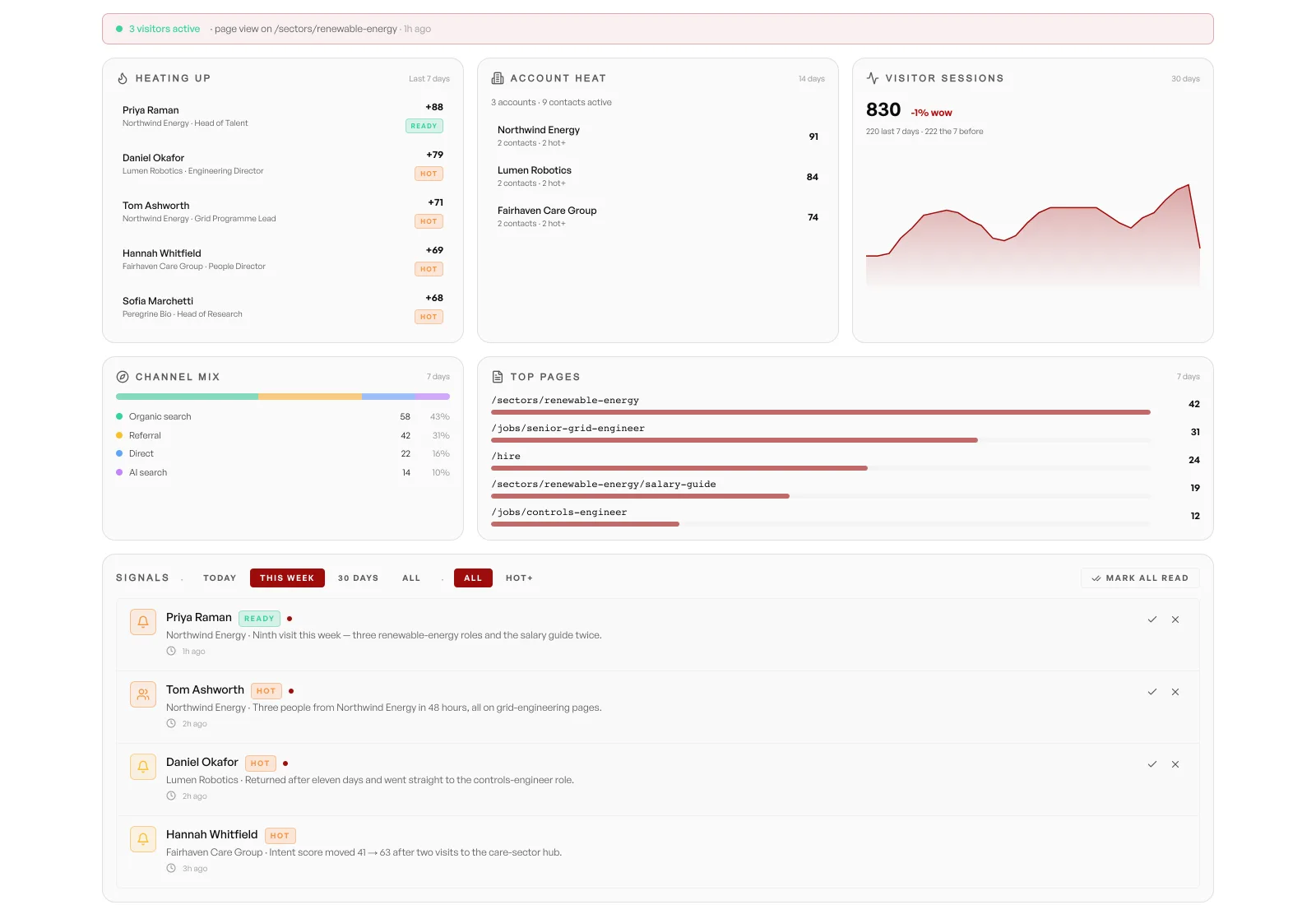
Website visitor intelligence for a recruitment agency is the practice of matching site activity to the people and companies already in the agency's CRM, then scoring how close each one is to a conversation. Redsun's Signals engine weights over thirty behaviours into a lifetime score per contact, groups contacts by employer, and alerts the owning consultant when a score crosses into hot or ready to contact.
One number, and the reason behind it.
Signals weights more than thirty kinds of behaviour into a lifetime score per contact, with per-session caps so one long browse cannot inflate it, and bonuses when actions arrive in a sequence that means something.
Cold
0–24Known to you, and browsing. Nothing yet that justifies a call.
Warm
25–49Coming back, and reading more than one thing. Worth a light touch.
Hot
50–79Deep in your roles or your sector pages. A consultant should have this name.
Ready
80+Behaving like someone about to enquire. Call today.
A score explains itself in the interface: open any contact and you see the events that earned each point, so a consultant can judge the number rather than trust it.
A score nobody reads is worth nothing.
Signals is judged on whether a consultant picks up the phone, so most of it is about getting the right name in front of the right person at the moment it matters.
Account heat
When two or more people from the same employer engage inside a fortnight, Signals rolls them up by company. One person reading your site is interest. Three from the same buying committee is a live requirement.
Threshold alerts
Crossing into Hot or Ready fires an alert with the engagement behind it, routed to the consultant who owns the relationship. Alerts can be assigned, snoozed and closed, so the list stays a list of work.
Return detection
A known contact coming back gets a plain-language nudge: who it is, what they looked at last time, how long ago. A cooldown stops the same return being announced twice.
CRM writeback
Engagement can be written back to your CRM as notes against the contact record, so the signal lands where your consultants already work instead of in a dashboard they have to remember to open.
What Signals will and will not tell you.
It names people your CRM already knows
Signals bridges browsing to a contact record through tracked campaign links and a hashed visitor ID. It does not buy an IP-to-company database and it will not tell you a stranger's employer.
It counts, it does not invent
Every row is a real event from your own site. Where there is nothing to show, a panel renders empty rather than filling itself with a plausible number.
Consent applies
Tracking runs behind your site's consent banner and the visitor's choice. Contacts can be excluded, and the whole engine can be switched off per tenant.
Signals is part of the Fusion plan. It runs on the traffic the rest of the platform earns you, so it pairs with Organic Growth for the visitors and Conversion Wells for the ones who are ready to put their name to something.
Signals FAQs
Common questions about visitor intelligence, intent scoring and what Redsun can identify.
- What is website visitor intelligence for a recruitment agency? +
- Website visitor intelligence is the practice of matching activity on an agency's website to the people and companies already in its CRM, then scoring how close each one is to a conversation. Redsun's Signals engine weights more than thirty behaviours into a lifetime score per contact: pages read, roles clicked, wells started, return visits, rolls those contacts up by employer, and alerts the owning consultant when a score crosses a threshold.
- Can Redsun tell me which companies visited my website? +
- It can tell you which companies your known contacts work for. Signals bridges browsing to a CRM contact record through tracked campaign links and a hashed visitor ID, then groups engaged contacts by the company name your CRM holds. When two or more people from the same employer engage within fourteen days, that account surfaces as heating up. Redsun does not run IP-to-company reverse lookup, so it will not name the employer of an anonymous stranger.
- How does Redsun score visitor intent? +
- A weighted model runs over the events your site records (page views, job clicks, well submissions, return visits and more) with per-session deduplication so one long browse cannot inflate a score, caps on repeated actions, and bonuses when actions arrive in a sequence that signals intent. The result is a lifetime score per contact placed in one of four tiers: Cold (0–24), Warm (25–49), Hot (50–79) and Ready to Contact (80+). Opening a contact shows the events behind the number.
- What happens when a contact becomes hot? +
- Crossing into Hot or Ready to Contact fires an alert carrying the engagement that triggered it. Alerts can be assigned to a consultant, snoozed, and closed, and they can be written back to your CRM as notes against the contact record so the signal lands where your team already works. A separate return-visit alert fires when a known contact comes back, with a 48-hour cooldown so the same return is not announced twice.
- Which plan includes Signals? +
- Signals is part of Fusion, the £599 per month plan, alongside the full SEO and AEO suite, live CRM-synced sections and intelligence reports. The Flare plan at £299 per month covers the website, job board, Conversion Wells and CRM sync without the visitor intelligence engine.
- Is visitor tracking GDPR compliant? +
- Tracking runs behind your site's consent banner and respects the visitor's choice, contacts can be excluded, and the engine can be switched off for a tenant entirely. Redsun acts as processor for the data your site collects; the agency remains the controller and sets the lawful basis, retention and privacy notice. Our DPA and subprocessor list set out the arrangement in full.
- How is Signals different from Google Analytics? +
- Google Analytics reports traffic in aggregate: sessions, channels, pages. It does not tell you that the operations director at a client you pitched last month has read your engineering sector page three times this week. Signals works at the level of a named contact your CRM already holds, scores that person's behaviour over time, and hands the result to a consultant as a call to make. Most agencies run both, and Redsun reports GA4 traffic in the same admin.
Related Products
Stop finding out after they went elsewhere.
See Signals running against a real account, and what it would surface on yours.